

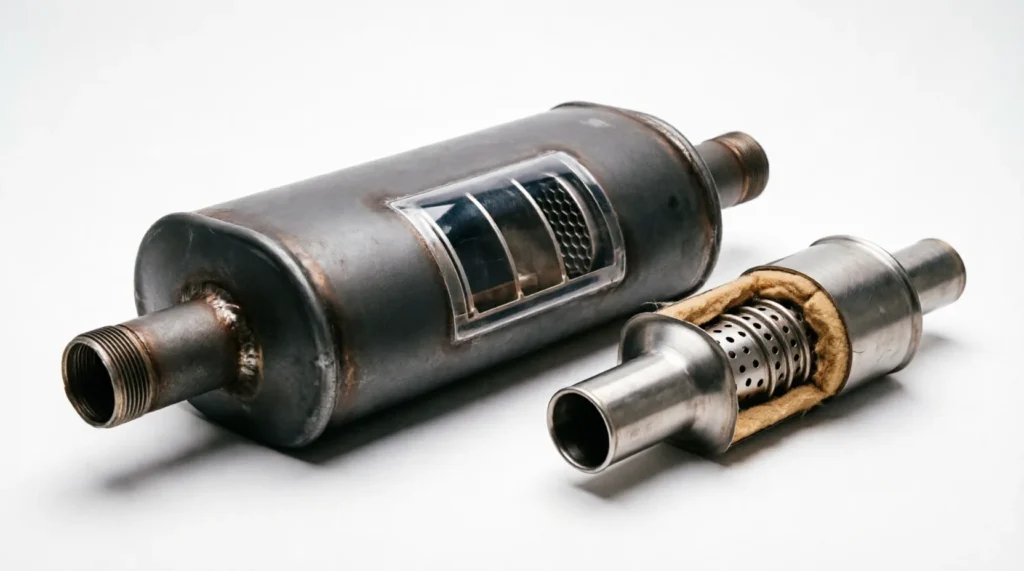
Quick answer: A muffler reduces overall exhaust volume across all frequencies using baffles and packing, while a resonator targets and cancels specific sound waves to eliminate drone without significantly lowering total decibels.
Car enthusiasts and DIY mechanics frequently confuse these two exhaust components because they both alter the sound of a vehicle, yet they serve fundamentally distinct acoustic purposes. The confusion usually stems from aftermarket marketing that uses the terms interchangeably, but in professional tuning and engineering, mistaking one for the other leads to disappointing results or unbearable cabin noise. Understanding the precise mechanical difference is the only way to achieve a specific exhaust note rather than just guessing at parts.
| Term | Meaning / When to use | Example sentence |
|---|---|---|
| Muffler | Use when referring to the component designed to reduce overall exhaust noise volume through absorption or reflection. | “The stock muffler was too restrictive, so I installed a high-flow performance muffler to increase horsepower.” |
| Resonator | Use when referring to the component designed to cancel specific sound frequencies to prevent drone or rasp. | “I added a J-pipe resonator to eliminate the 3,000 RPM highway drone without making the car quieter overall.” |
When to use muffler
You must use the word muffler when you are discussing general noise suppression, backpressure management, or the final stage of exhaust gas treatment before atmospheric release. In my years editing automotive technical manuals and forum posts, I see writers incorrectly label any silencing device as a resonator, but a true muffler is a broadband attenuator. It functions similarly to how acoustic insulation works in a recording studio, treating a wide spectrum of sound rather than a single pitch. According to Difference, distinguishing between two entities requires identifying the specific attributes that separate them; in this case, the muffler’s attribute is broad-spectrum amplitude reduction via chambers, perforated tubes, and fiberglass packing.
Here are three realistic contexts where muffler is the only correct term:
- Emissions and inspection compliance: “The inspector failed the vehicle because the modified muffler did not meet the state’s minimum decibel rating for street-legal exhaust systems.” (Using “resonator” here would be technically incorrect because inspections measure total volume, which is the muffler’s domain.)
- Performance part selection: “When choosing a performance muffler, prioritize straight-through designs over chambered ones if you want maximum flow with moderate tone.” (This refers to internal construction meant to manage overall gas velocity and sound energy.)
- Diagnostic repair orders: “Customer reports loud popping on deceleration; inspect rear muffler for internal baffle failure or rust perforation.” (Popping and general loudness indicate a failure of the primary silencing device, not a frequency-specific tuner.)
If you are writing product descriptions, service invoices, or technical guides, reserve muffler for discussions about total sound pressure levels (SPL), legal compliance, and general tone shaping. Using it to describe a device that only fixes a specific frequency makes your writing imprecise and signals to knowledgeable readers that you lack hands-on experience. I have corrected countless eBay listings where sellers advertised “universal resonators” that were actually packed mufflers; this mislabeling causes returns because buyers expecting drone elimination receive unwanted volume reduction instead.
When to use resonator
Use the word resonator exclusively when describing a component engineered to target, amplify, or cancel specific sound frequencies through Helmholtz resonance or quarter-wave tuning. Unlike a muffler, a resonator does not necessarily make an exhaust system quieter in terms of raw decibels; it changes the character of the sound by addressing problematic harmonics. As defined in physics, a Resonator is a device that exhibits resonance, meaning it naturally oscillates at certain frequencies with greater amplitude than others, allowing it to act as an acoustic filter rather than a blanket damper. This distinction is critical when diagnosing cabin drone, which is caused by standing waves at specific engine RPMs that a standard muffler cannot effectively address.
Consider these three scenarios where resonator is the required terminology:
- Drone elimination tuning: “After installing long-tube headers, I experienced severe cabin drone at 2,800 RPM, so I welded in a quarter-wave resonator tuned to 115 Hz to cancel that specific frequency.” (A muffler would have reduced overall volume but likely failed to eliminate the standing wave causing the physical vibration.)
- Exhaust note refinement: “The cat-back system sounded raspy and tinny under load, so we added a front resonator to smooth out the mid-range frequencies without sacrificing top-end volume.” (This describes tonal shaping, not volume reduction.)
- OEM replacement identification: “The factory exhaust includes a pre-muffler resonator specifically designed to cancel the four-cylinder engine’s secondary harmonic before gases reach the main silencer.” (Manufacturers use resonators as precision tools in multi-stage systems; calling this a ‘pre-muffler’ is colloquially acceptable but technically vague.)
In professional exhaust fabrication, the resonator is a surgical tool while the muffler is a sledgehammer. If you are documenting a build, writing a review, or explaining a fix to a customer, using resonator correctly demonstrates that you understand acoustic physics rather than just parts swapping. I once edited a magazine feature where the author claimed a new axle-back muffler “fixed the drone,” but the accompanying photos showed a clearly labeled Helmholtz resonator; correcting this error preserved the publication’s credibility with technical readers who know that axle-back mufflers rarely solve drone issues rooted in header primaries or mid-pipe geometry.
How to remember the difference
The most reliable mnemonic I teach apprentices and junior editors is “Muffle = Mute, Resonate = Tune.” Both words share phonetic roots with their functions: “muffle” sounds like “mute” or “mushy,” implying softening and broad suppression, while “resonate” shares a root with “frequency,” “tone,” and “tune,” implying specificity and harmonic interaction. When you encounter the word in a draft or conversation, ask yourself whether the subject is reducing everything (muffler) or targeting something specific (resonator).
Another editor-level trick is to visualize the internal construction. Mufflers contain chaotic, absorptive materials like steel wool, fiberglass, or complex labyrinth chambers that scatter sound indiscriminately. Resonators contain precise, empty volumes or perforated tubes calculated to exact dimensions based on the speed of sound and target frequency. If the description mentions “packing,” “baffles,” or “absorption,” it is a muffler. If it mentions “tuned,” “Helmholtz,” “quarter-wave,” or “chamber volume,” it is a resonator. This visual check catches errors even when the writer has used plausible-sounding but incorrect terminology.
Finally, apply the “volume knob vs. equalizer” test. A muffler acts like a master volume knob, turning everything down equally. A resonator acts like a parametric equalizer slider, boosting or cutting only a narrow band of frequencies. If the context involves making a car “quieter overall,” write muffler. If it involves making a car “sound better” or “stop vibrating at highway speeds” without necessarily being quieter, write resonator. This functional analogy bridges the gap between abstract acoustics and practical garage language, ensuring your word choice matches the actual mechanical outcome.
Common mistakes and exceptions
The most pervasive error I encounter is using “resonator” as a synonym for “small muffler” or “pre-muffler.” Many budget aftermarket brands sell packed silencers labeled as resonators simply because they are smaller than traditional mufflers, but internally they function as broadband absorbers. True resonators are typically hollow or contain precisely tuned perforations without significant packing material. Always verify internal construction or manufacturer specifications before accepting the label; if it contains fiberglass batting, it is functionally a muffler regardless of what the box says.
Another frequent mistake is assuming resonators always reduce noise. In performance applications, resonators can actually amplify desirable frequencies to enhance exhaust note, functioning as acoustic amplifiers rather than dampeners. Writers who default to “resonators quiet things down” miss half the component’s utility. Conversely, some high-performance mufflers use resonator-style tuning chambers internally, creating hybrid devices that blur the line; in these cases, defer to the manufacturer’s primary classification but acknowledge the hybrid nature in technical writing.
Regional and industry variations also cause confusion. In British English and some European markets, “silencer” is the preferred term for what Americans call a muffler, while “resonator” remains consistent globally. Additionally, motorcycle and small-engine communities sometimes use “db killer” or “baffle” to refer to insertable restrictors that function as mini-mufflers; avoid applying these niche terms to automotive exhaust writing unless specifically covering that subculture. Finally, OEM service manuals may use proprietary names like “intermediate silencer” or “auxiliary muffler” for components that function as resonators; when quoting factory documentation, preserve the original term but clarify its functional equivalent in parentheses for general audiences.
Frequently Asked Questions
Can I replace my muffler with a resonator to pass inspection? No, because resonators do not provide sufficient broadband noise reduction to meet legal decibel limits in most jurisdictions. Inspections measure total sound pressure level, which requires a proper muffler; a resonator alone will typically result in a failed test and potential fines.
Why does my car still drone after installing a new performance muffler? Drone is caused by specific frequency standing waves that broadband mufflers cannot target, requiring a tuned resonator to cancel the problematic harmonic. You likely need to add a Helmholtz or quarter-wave resonator upstream of the muffler, sized specifically for your engine’s displacement and the RPM range where drone occurs.
Is a resonator the same as a catalytic converter? Absolutely not; a catalytic converter treats exhaust emissions chemically while a resonator treats sound acoustically, and they are never interchangeable. Removing a catalytic converter and replacing it with a resonator is illegal in all 50 states and will trigger check engine lights due to missing O2 sensor feedback.
Do I need both a muffler and a resonator on my exhaust system? Most well-designed performance exhaust systems benefit from both: a resonator to tune the note and eliminate drone, plus a muffler to control overall volume for street legality. Race-only vehicles may use only resonators for tone shaping without volume concerns, but daily drivers typically require the combination to balance sound quality with neighbor-friendly operation.

Daniel Perez is a seasoned editor and author with over 10 years of experience in content creation and word analysis. He graduated with a Bachelor’s degree in English Literature from Stanford University, where he discovered his passion for words and their interrelationships. His initial curiosity about wordplay and puns led him to explore deeper linguistic structures, eventually focusing on English word comparisons. Daniel is known for his analytical skills in distinguishing subtle differences between closely related words and expressions. At CompareMyWords, Daniel writes content that caters to both professional linguists and casual language enthusiasts, offering insight into grammatical intricacies, homonyms, and the impact of technology on modern language usage. He is particularly passionate about making linguistic knowledge accessible and engaging to a broad audience.