

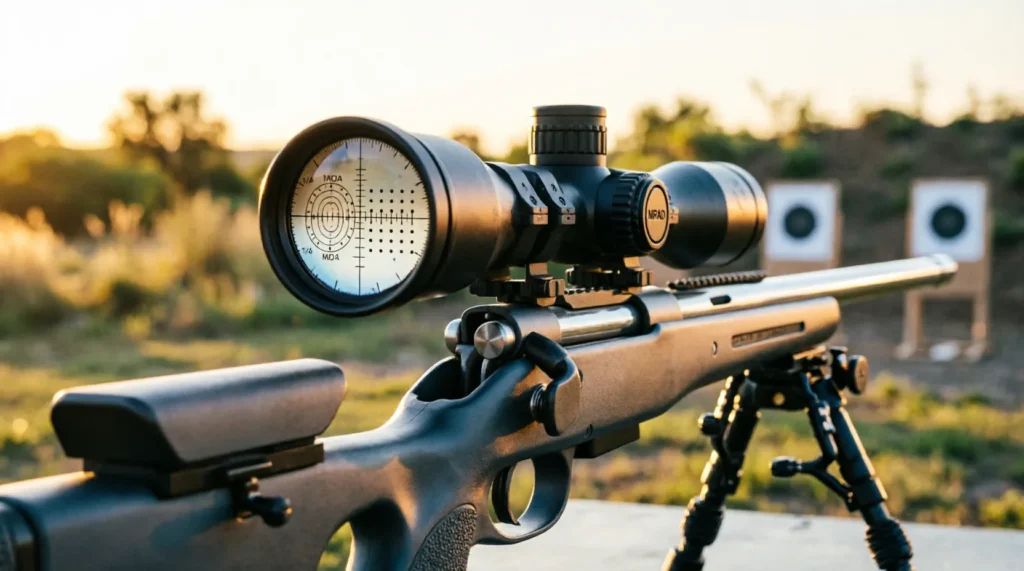
Quick answer: MOA (Minute of Angle) is an angular measurement based on degrees where 1 MOA equals 1/60th of a degree, while MRAD (Milliradian) is a metric-based angular unit where 1 MRAD equals 1/1000th of a radian; the critical practical difference is that 1 MOA subtends approximately 1.047 inches at 100 yards, whereas 1 MRAD subtends exactly 10 centimeters at 100 meters.
Shooters, editors, and technical writers frequently conflate these two angular units because both describe reticle measurements and scope adjustments, yet they originate from entirely different mathematical systems. The confusion stems from overlapping usage in long-range shooting communities, but as a copy editor who has corrected hundreds of firearms manuscripts and ballistics articles, I can confirm that treating them as interchangeable introduces calculation errors that compound drastically at distance. Understanding the precise distinction between MOA and MRAD is not merely academic; it determines whether your elevation correction lands on target or misses by feet.
| Term | Meaning / When to use | Example sentence |
|---|---|---|
| MOA | Minute of Angle; use when referencing imperial ballistic tables, US-manufactured scopes with ¼-MOA turrets, or traditional American marksmanship literature. | “The shooter dialed 3.5 MOA of elevation to compensate for bullet drop at 600 yards.” |
| MRAD | Milliradian; use when referencing metric ballistic data, military/NATO optics, or precision rifle competitions using decimal-based holdovers. | “She adjusted her scope 2.8 MRAD left to correct for wind drift at 800 meters.” |
When to Use MOA
MOA is the standard unit in American civilian shooting and legacy ballistic literature, rooted in the sexagesimal system of dividing a circle into 360 degrees. According to Difference, distinguishing between two similar concepts requires identifying their foundational properties, and for MOA, that foundation is the degree-based circle division where each degree contains 60 minutes. You should use MOA exclusively when working with equipment calibrated in this unit or communicating with audiences expecting imperial measurements.
- “My new hunting scope has ¼-MOA click values, so I need four clicks per MOA of adjustment.”
- “The ballistics chart shows 12.3 MOA of drop at 500 yards for this .308 load.”
- “Please verify the target size in MOA before calculating the range estimation formula.”
I recently edited a magazine feature where the author wrote, “I held 2 mils high” while describing a scope clearly marked in MOA increments; the sentence was factually wrong and would have misled readers attempting to replicate the shot. The fix required converting the holdover to MOA or specifying that the shooter used a separate MRAD reticle, demonstrating why unit consistency matters in published content. Always match the terminology to the hardware: if the turrets click in MOA, every written reference must also be in MOA.
Use MOA when drafting content for American hunting publications, NRA-sanctioned competition guides, or product descriptions for domestically manufactured optics. Mixing MRAD terminology into these contexts signals unfamiliarity with the audience’s equipment and erodes credibility. Conversely, never force MOA into metric-focused tactical writing, as the resulting conversion friction defeats the purpose of using a coherent measurement system.
When to Use MRAD
MRAD belongs to the International System of Units and defines angle through the ratio of arc length to radius, making it inherently compatible with metric distance measurements. One milliradian represents 1/1000th of a radian, which translates to 10 centimeters of subtension at 100 meters—a clean decimal relationship that simplifies mental math for metric users. Employ MRAD whenever your source data, equipment, or audience operates within the metric framework.
- “The spotter called a 0.6 MRAD wind correction for the 900-meter engagement.”
- “This PRS match uses MRAD-only scoring to maintain consistency across international competitors.”
- “Convert your DOPE book to MRAD if you’re switching to a NATO-spec optic.”
During a technical manual review last year, I encountered a paragraph stating, “Adjust 1 mil for every 100 yards of range,” which dangerously conflated MRAD with yardage; the correct statement should have specified meters or converted the value to MOA for yard-based distances. Such errors are not just stylistic—they produce real-world aiming mistakes when shooters apply incorrect corrections. MRAD’s advantage lies in its base-10 coherence, so preserve that advantage by keeping all associated measurements metric.
Choose MRAD for military documentation, law enforcement training materials, international competition coverage, and any content targeting precision rifle shooters who think in meters and centimeters. The term “mil” is acceptable shorthand in informal contexts, but formal writing should spell out “MRAD” or “milliradian” on first reference to avoid ambiguity with other meanings of “mil.” Never use MRAD when describing vintage American optics or historical ballistics, as anachronistic terminology confuses readers about the era’s actual practices.
How to Remember the Difference
The most reliable mnemonic I teach new editors ties each unit to its measurement system’s cultural origin: MOA = Minutes Of America (imperial, degrees, inches) and MRAD = Metric RADian (metric, radians, centimeters). This association works because it links the unfamiliar term to something already familiar—the geographic and systemic context where each unit dominates. When you encounter either term in a manuscript, immediately check whether the surrounding numbers are imperial or metric; mismatched systems almost always indicate an error.
Another editor-level trick involves the “100” anchor point: at 100 units of distance, 1 MOA ≈ 1 inch (actually 1.047″) while 1 MRAD = 10 cm. If a sentence claims “1 MOA equals 10 cm at 100 meters,” the writer has swapped the units. This numerical checkpoint catches transposition errors faster than re-deriving formulas. I keep this reference card taped to my monitor during ballistics edits because even experienced writers occasionally reverse the values under deadline pressure.
Finally, remember that MOA divides circles (360° × 60′ = 21,600 MOA per circle) while MRAD divides radians (~6,283 MRAD per circle). This fundamental Between structural distinction means the two units will never align perfectly, regardless of rounding. Accepting their inherent incompatibility prevents the false hope of finding a “universal” conversion factor and encourages disciplined unit tracking throughout any project.
Common Mistakes and Exceptions
The single most pervasive error I correct is treating “mil” as synonymous with MRAD without verification; some older Soviet optics used non-standard mil definitions (e.g., 6,000 mils per circle instead of 6,283), making assumed conversions inaccurate. Always confirm the specific mil definition before publishing ballistic advice, especially when citing foreign manuals or vintage equipment. Similarly, many shooters round 1 MOA to exactly 1 inch at 100 yards for convenience, but this approximation accumulates to over 4 inches of error at 1,000 yards—unacceptable in precision contexts. Specify “approximately 1 inch” for casual content and “1.047 inches” for technical accuracy.
US vs. UK differences rarely affect MOA/MRAD usage directly, since both regions adopt the same angular definitions, but spelling conventions matter: British publications may prefer “milliradian” spelled out more frequently, while American tactical writing favors “MRAD” as an acronym. Maintain consistency with the publication’s style guide rather than personal preference. Another exception arises in hybrid optics featuring both MOA and MRAD markings; when documenting these, explicitly state which scale applies to each adjustment to prevent reader confusion.
Avoid the phrase “MOA vs. MRAD” in headings unless comparing them directly; instead, use “difference between MOA and MRAD” to match search intent and reduce ambiguity. I’ve seen SEO-driven articles title sections “MOA or MRAD?” which implies choice rather than distinction, misleading readers into thinking one replaces the other. Both coexist legitimately; the writer’s job is clarifying context, not declaring superiority. Lastly, never capitalize “moa” or “mrad” in running text unless starting a sentence—they are units, not proper nouns, and lowercase follows SI and NIST conventions.
Frequently Asked Questions
Can I convert MOA to MRAD mentally without a calculator? Yes, approximate 1 MOA as 0.29 MRAD (or roughly 0.3 for field estimates), but recognize this introduces ~3% error that compounds at distance; use exact conversion (1 MOA = 0.290888 MRAD) for published ballistic tables.
Why do some scopes have mixed MOA and MRAD markings? Manufacturers sometimes combine reticles and turrets to serve diverse markets, but this creates operational risk; always specify which scale governs adjustments in documentation to prevent user error.
Is “mil” always shorthand for MRAD? No—”mil” historically referred to various artillery units including 6,400-mil NATO circles and 6,000-mil Warsaw Pact systems; verify the specific definition before assuming equivalence to milliradians.
Does the difference between MOA and MRAD matter for short-range shooting? At distances under 200 yards/meters, the practical impact is negligible for most applications, but maintaining consistent units builds discipline that prevents catastrophic errors when engaging longer ranges.

Kevin Williams holds a Master’s degree in English Language and Linguistics from the University of Edinburgh and brings over 15 years of experience to the field of lexical analysis and English word comparisons. His fascination with the nuances and subtleties of the English language began during an undergraduate project, which inspired him to further delve into the intricacies of semantic variances and etymological roots. His expertise lies in breaking down complex word pairings and explaining their evolution, especially in modern vernacular and historical usage. Kevin is particularly interested in how context and culture shape word meanings and their usage in diverse settings. He conducts in-depth analyses and writes engaging, accessible articles and comparative studies on word origins, synonyms, antonyms, and idiomatic expressions for CompareMyWords. His contributions aim to enlighten readers with a greater understanding of language intricacies.