

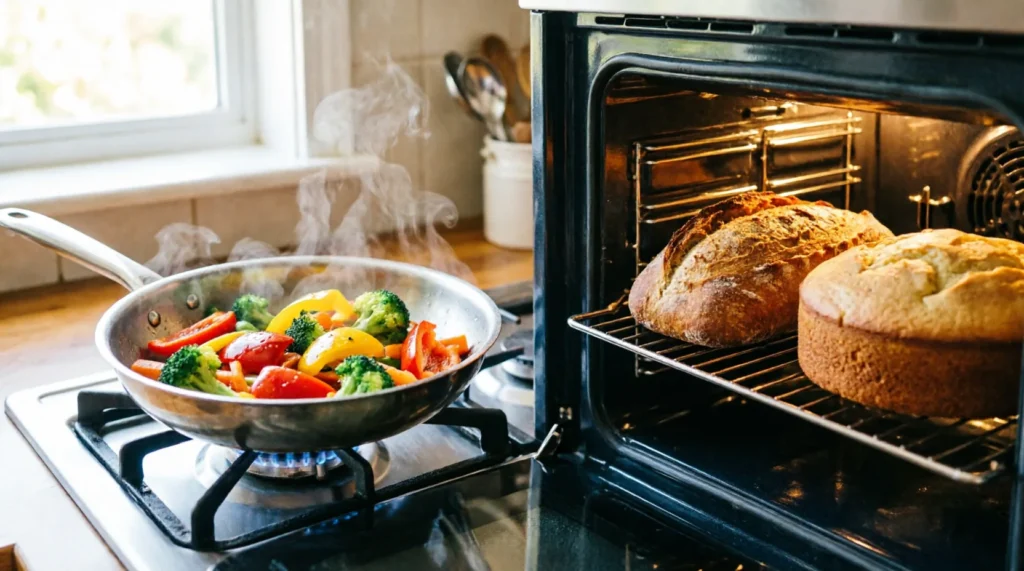
Quick answer: Cooking is the umbrella term for preparing food with heat by any method, and baking is one specific method under that umbrella: cooking with dry, indirect heat inside an oven. Every time you bake, you are also cooking; most of the time you cook, you are not baking.
I have corrected this exact pair of words in cover letters, résumés, wedding toasts, and cookbook manuscripts for over a decade, and the error pattern never changes: people reach for the general word where the specific one is required, and the reverse. The confusion is understandable, because both words involve heat, both end in “-ing,” and both happen in the same kitchen. The fix takes one rule: one word names the whole category, and the other names a single method inside it.
One grammar aside before the rules. This comparison joins exactly two items, and English reserves the preposition “between” for precisely that situation, a one-to-one relationship involving two separate items, as the Wikipedia entry on Between describes. Keep that two-item framing in mind, because it is the whole article in miniature: two words, two distinct jobs.
Baking vs. Cooking at a Glance
| Term | Meaning / When to use | Example sentence |
|---|---|---|
| Baking | Cooking food with dry, indirect heat that surrounds it inside an oven. Use it for breads, cakes, cookies, pastries, pies, casseroles, and anything that begins as a batter or dough and then sets, rises, or browns. | “She is baking three sourdough loaves for the Saturday farmers’ market.” |
| Cooking | The general act of preparing food with heat by any method: sautéing, boiling, steaming, grilling, frying, roasting, or baking. Use it as your default whenever the method is mixed, unknown, or simply not the point of the sentence. | “He is cooking dinner for six guests on the stovetop tonight.” |
When to use baking
Use baking when the oven does the work. The plain-English rule: if the heat is dry, indirect, and circulating inside a closed oven, and especially if the dish begins life as a dough, batter, or paste, the verb is “bake.” Bread, cakes, cookies, muffins, scones, pies, tarts, and quick breads take “bake” without exception.
A text from my sister last spring read, “I’m cooking cookies for the bake sale, wish me luck.” I sent back the fix: “I’m baking cookies for the bake sale.” Cookies exist only because of the oven’s dry heat, and “cooking” painted a picture of cookies sizzling in a skillet.
A résumé I corrected for a job applicant claimed she “cooked bread, scones, and croissants at a neighborhood café for two years.” I changed it to “baked bread, scones, and croissants.” In a professional kitchen the oven station belongs to the baker, and a hiring chef reads “cooked bread” as a red flag.
“The lasagna is baking at 375°F for 45 minutes.” Casseroles, gratins, and anything that sets in a baking dish take “bake” even when no sugar is anywhere in sight.
Notice the temperature cue, too. Recipes say “bake at 350,” never “cook at 350.” When a degree number follows the verb, the oven word follows.
When to use cooking
Use cooking as your default verb and your umbrella noun. The rule: if the heat comes from a burner under a pan, a grill grate, a wok, a steamer basket, or an open flame, or if you do not care to name the method at all, the word is “cook.” It is the safe, always-true word for turning raw ingredients into a meal.
“I’m cooking pasta while the sauce simmers.” Boiling water on a burner is stovetop territory, and “baking” would be nonsense here.
An email from a recipe-testing client told me, “We baked the chicken in a skillet on the hob for twenty minutes.” A skillet on a burner delivers direct heat from below, so I changed it to “We cooked the chicken in a skillet for twenty minutes,” and suggested “seared” as the sharper verb.
“My grandmother cooked for eight people every Sunday for forty years.” A lifetime of mixed methods, stewing, frying, roasting, boiling, takes the umbrella word, because no single method tells the story.
Guests peek into the kitchen and ask, “What are you cooking?” never “What are you baking?” unless the smell of bread gives the answer away. The default question uses the default word.
Here is the asymmetry to remember. “Cooking” is never factually wrong about oven food, since the turkey is, technically, cooking in the oven, so it is never an error, only a vagueness. The real error runs one direction: using “cooking” where English demands the specific word, or using “baking” for food that never meets the oven.
How to remember the difference
My favorite mnemonic is five words long: baking happens in a box. The oven is a closed metal box of dry, circulating heat, and the stovetop is not a box at all. If the heat wraps around the food from every side, bake. If it blasts upward from a burner into the bottom of a pan, cook.
A second, editor-level trick is the swap test. You can replace “baking” with “cooking” and stay technically true, since “she is cooking a cake” describes reality, just vaguely, while the reverse swap collapses: “she is baking a stew on the stovetop” is instantly wrong. The word that can be swapped out is the specific one, baking, and the word that survives every swap is the category, cooking. Run the swap test on any doubtful sentence and it will tell you which word you actually needed.
Reference works define a difference as the quality that makes two comparable things unlike, and the unlike quality between these two words is the path the heat travels: enclosed and indirect for baking, open and direct, or simply unnamed, for cooking. Pin down the heat’s path and the vocabulary takes care of itself.
One last memory hook from kitchen culture: baking is chemistry, cooking is conversation. Bakers weigh flour and set timers because ratios drive the rise, while cooks taste, adjust, and add a pinch by feel. When your sentence involves measuring cups and oven timers, “baking” is almost certainly your word.
Common mistakes and exceptions
Even with the box mnemonic in hand, a few edge cases trip up careful writers. Here are the ones I flag most often in manuscripts.
Oven food without dough still takes “bake”: baked potatoes, baked beans, baked ziti, baked salmon, baked chicken thighs. The dough test has exceptions, and the enclosed-oven test wins every time.
Whole cuts of meat in the oven switch to a third word entirely: you roast a chicken, a turkey, a leg of lamb, a beef joint. “Baking a chicken” sounds wrong to every native ear unless the bird sits breaded in a casserole. Roasting is baking’s cousin: same box, different guest.
“Cooking a cake” is never acceptable in any register I have edited, from text messages to wedding toasts. Meanwhile “cooking a casserole” and “baking a casserole” both pass, with a small shift of emphasis. Casseroles are the swing vote of the kitchen.
British and American kitchens rename the equipment but keep the rule. In the UK a “cooker” is the entire appliance, oven plus hob, while Americans call it a “stove” or “range” and reserve “cooker” for a slow cooker or rice cooker. Brits buy “cooking apples” for what Americans call “baking apples,” and a UK “baking tray” crosses the Atlantic as a “baking sheet” or “cookie sheet.” Neither dialect, however, ever says “cooking a cake,” so the core rule holds on both sides of the ocean.
Idioms are fixed furniture, so do not swap their verbs. Costs are “baked into” a quote and sunbathers are “baking” on the beach, but a fraud “cooks the books,” a host asks “what’s cooking?,” and a project finally moving is “cooking with gas.”
Frequently Asked Questions
Is baking a type of cooking? Yes. Baking is one heat method inside the larger category of cooking, a sibling of roasting, grilling, frying, steaming, and boiling.
Why is baking considered more precise than cooking? Baked goods depend on fixed ratios of flour, fat, sugar, and leavening that react chemically in the oven, while stovetop cooking forgives tasting and adjusting as you go.
Do you say baking or cooking for pizza? Pizza is baked, because a deck oven’s dry, enclosed heat sets the dough and blisters the crust, though “cooking pizza” passes in casual speech as the umbrella term.
Is grilling baking or cooking? Grilling is cooking, not baking, because the heat is direct from a grate rather than enclosed, circulating dry air.

Daniel Perez is a seasoned editor and author with over 10 years of experience in content creation and word analysis. He graduated with a Bachelor’s degree in English Literature from Stanford University, where he discovered his passion for words and their interrelationships. His initial curiosity about wordplay and puns led him to explore deeper linguistic structures, eventually focusing on English word comparisons. Daniel is known for his analytical skills in distinguishing subtle differences between closely related words and expressions. At CompareMyWords, Daniel writes content that caters to both professional linguists and casual language enthusiasts, offering insight into grammatical intricacies, homonyms, and the impact of technology on modern language usage. He is particularly passionate about making linguistic knowledge accessible and engaging to a broad audience.