

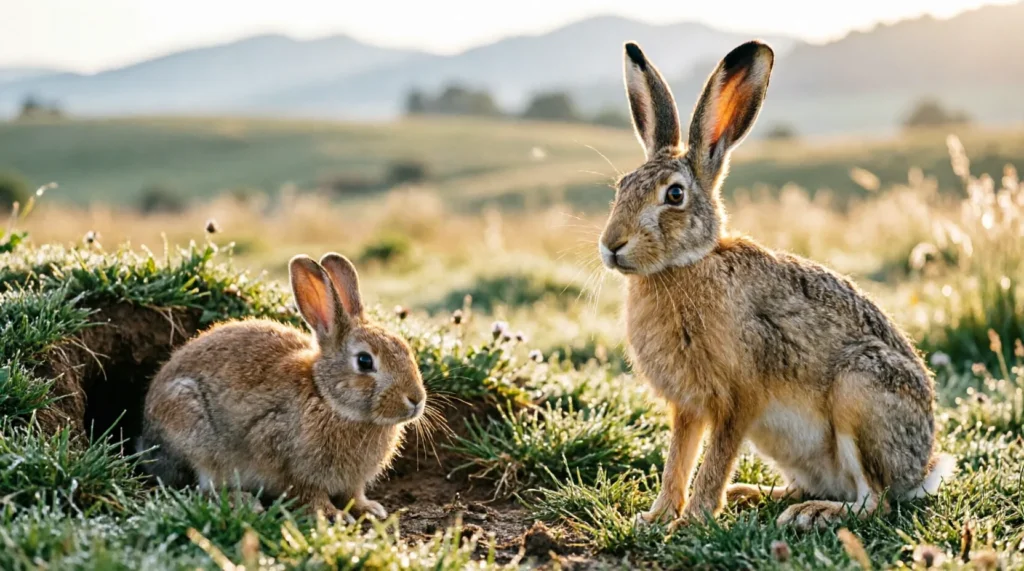
Quick answer: A bunny is a casual, affectionate nickname for a rabbit—reserve it for pets, picture books, and the Easter Bunny. A hare is a different wild animal entirely: longer black-tipped ears, longer legs, babies born furred with eyes open, and no burrow. In formal writing, the neutral word is usually rabbit, and “bunny” should be struck on sight.
I have edited nature-center newsletters, pet-brand copy, and more school essays than I can count where these two words get swapped like loose buttons. The confusion is understandable: hares and rabbits belong to the same family, Leporidae, they look alike at a glance, and “bunny” was never a scientific term to begin with—it is a pet name that people slap onto anything with long ears. But the words are not interchangeable, and the fix takes one minute to learn.
| Term | Meaning / When to use | Example sentence |
|---|---|---|
| Bunny | An informal, affectionate nickname for a rabbit, especially a young one. Use in casual speech, children’s contexts, pets, and fixed idioms like “Easter Bunny.” Avoid in scientific and formal writing. | “The girls named the new bunny Clover.” |
| Hare | The precise term for the wild sprinter of the genus Lepus—larger than a rabbit, with longer ears and legs, and babies born ready to run. Use in factual, formal, or scientific writing, and in idioms like “March hare.” | “The hare zigzagged across the field and outran the hound.” |
| Rabbit (for reference) | The neutral, all-purpose term for the burrow-dwelling animal. The default word in formal writing whenever the animal is a rabbit. | “The study tracked rabbit populations across three counties.” |
When to use bunny
Use bunny when the register is warm, casual, or child-directed, and the animal in question is a rabbit. It is the word for pets, plush toys, storybooks, and playground chatter. It is not the word for a biology report, a news story, or a cover letter—and I say that as someone who has removed it from all three.
In a single month of client work last spring, I cut “bunny” from a wedding invitation suite, a LinkedIn bio (“rescued bunny fosterer” became “rabbit fosterer”), and a museum appeal letter. Every writer meant rabbit. The word bunny had crept in because it is the softer, cuter option—and cuteness is exactly what formal prose cannot afford.
Correct uses:
- “The girls named the new bunny Clover.” (a family pet)
- “The preschool’s Easter bunny arrives at ten sharp.” (a fixed idiom—note the capital B in Easter Bunny)
- “She tucked a stuffed bunny into the hospital gift bag.” (a toy, not an animal at all)
If the animal is wild and you are writing factually, “bunny” is the wrong register even when the animal genuinely is a rabbit. If the animal is a hare, “bunny” is wrong twice over—wrong species and wrong register.
One last note: “bunny” occasionally stops referring to animals entirely. A “snow bunny” is a skier, and a “bunny slope” is a beginner run. In those fixed slang phrases, the word stays exactly as it is.
When to use hare
Use hare only when the animal truly is a hare—a wild sprinter of the genus Lepus, some 32 species worldwide—or when you are inside a fixed idiom. Before you commit to the word, check the field marks:
- Ears: longer than a rabbit’s, usually tipped in black.
- Legs: longer and more powerful; a hare can hit roughly 45 miles per hour in a zigzag sprint.
- Babies: called leverets, born furred with eyes open and mobile within hours.
- Home: a shallow grass depression called a form, never an underground burrow.
Correct uses:
- “The hare zigzagged across the field and outran the hound.”
- “Despite its nickname, the jackrabbit of the American West is a hare.”
- “He bolted into the meeting like a March hare.” (idiom)
If you are describing the animal that races down a highway shoulder with enormous black-tipped ears, that is a hare, and calling it a bunny turns your field note into a storybook line. The same goes for the snowshoe hare, which turns white in winter and is mislabeled a “snow bunny” in roughly half the holiday cards that cross my desk every December.
How to remember the difference
Here is the rhyme I hand every new editor on day one: hare rhymes with air—and hares live their whole lives in the open air. They nest in grass forms, never underground. Bunny’s B ties it to baby and burrow: bunnies are rabbits, and rabbits raise their blind, hairless kits in underground burrows. One rhyme, two anchors, no more guessing.
According to Difference, a difference is simply what distinguishes one thing from another—and the distinction here runs on two axes at once: the animal (rabbit versus hare) and the register (casual versus precise). Anchor each word to a single picture and the axes line up: the hare is the wild athlete you watch from a distance, and the bunny is the soft pet you let a toddler name.
Then apply the register test I use at my own desk: would this word survive on a veterinary clinic’s intake form? “Rabbit” and “hare” would. “Bunny” would not. That single question settles nearly every case, including the tricky ones where the animal itself is ambiguous.
Common mistakes and exceptions
The errors I see most often, in rough order of frequency:
- Calling a highway sprinter a bunny. If it is racing your car with black-tipped ears, it is a hare—in North America, often a jackrabbit.
- Calling a petting-zoo animal a hare. Petting zoos keep rabbits. Hares are wild, skittish, and do not tolerate handling.
- Writing “hair-brained.” The idiom is harebrained, one word, from the old idea of the hare as a frantic, foolish creature. I see this error constantly in cover letters.
- Reaching for “bunny” in formal copy. A museum placard reading “the snowshoe bunny” must become “snowshoe hare,” because that animal is, in fact, a hare.
The exceptions worth memorizing:
- The Belgian Hare is a domestic rabbit breed with a hare-like look and a misleading name. The name is historical; the animal is a rabbit.
- The jackrabbit is a hare, not a rabbit, despite its American nickname.
- Easter Bunny, March hare, and the tortoise and the hare are fixed idioms. Do not “correct” them.
- In older British texts you will meet coney (or cony), the archaic word for a rabbit—handy for place names, useless for new writing.
On the US-versus-UK question: unlike gray/grey or color/colour, there is no transatlantic split here. Both sides spell and use “hare” and “bunny” identically. The only divide is register, and it is the same on both shores: “bunny” is nursery talk, “hare” is field-guide talk. When you are choosing between the two words in a sentence, ask one question—am I reporting a fact, or am I evoking a cuddle?—and the choice makes itself.
Three real fixes from my editing desk
- A client email about a farm visit: “The kids petted a soft little hare at the petting zoo.” → Fixed: “The kids petted a soft little bunny at the petting zoo.” Hares are not in petting zoos.
- A résumé line for an early-education job: “I taught preschoolers the story of the Easter Hare.” → Fixed: “the Easter Bunny.” The idiom is fixed, and the capital B matters.
- A text message that became a travel-blog draft: “We saw a tiny bunny with huge black-tipped ears racing the highway.” → Fixed: “We spotted a hare—likely a jackrabbit—racing the highway.” The speed and the black-tipped ears give it away.
Frequently Asked Questions
Is a bunny a baby hare? No. A baby hare is a leveret, and a hare never becomes a bunny. “Bunny” is a nickname for a rabbit, usually a young one.
Can hares and rabbits interbreed? No. They share a family (Leporidae) but not a genus, and they cannot crossbreed—which is a large part of why the words are not interchangeable.
Should I use “bunny” in an essay, article, or report? Only when quoting a child or writing about pets and idioms. Otherwise use “rabbit” for the animal, and reserve “hare” for the genus Lepus.
Why do Americans say “jackrabbit” if it is a hare? Nineteenth-century settlers named it for its size and leaping style, and the nickname stuck. Field guides have been quietly correcting the record ever since.

Kevin Williams holds a Master’s degree in English Language and Linguistics from the University of Edinburgh and brings over 15 years of experience to the field of lexical analysis and English word comparisons. His fascination with the nuances and subtleties of the English language began during an undergraduate project, which inspired him to further delve into the intricacies of semantic variances and etymological roots. His expertise lies in breaking down complex word pairings and explaining their evolution, especially in modern vernacular and historical usage. Kevin is particularly interested in how context and culture shape word meanings and their usage in diverse settings. He conducts in-depth analyses and writes engaging, accessible articles and comparative studies on word origins, synonyms, antonyms, and idiomatic expressions for CompareMyWords. His contributions aim to enlighten readers with a greater understanding of language intricacies.