

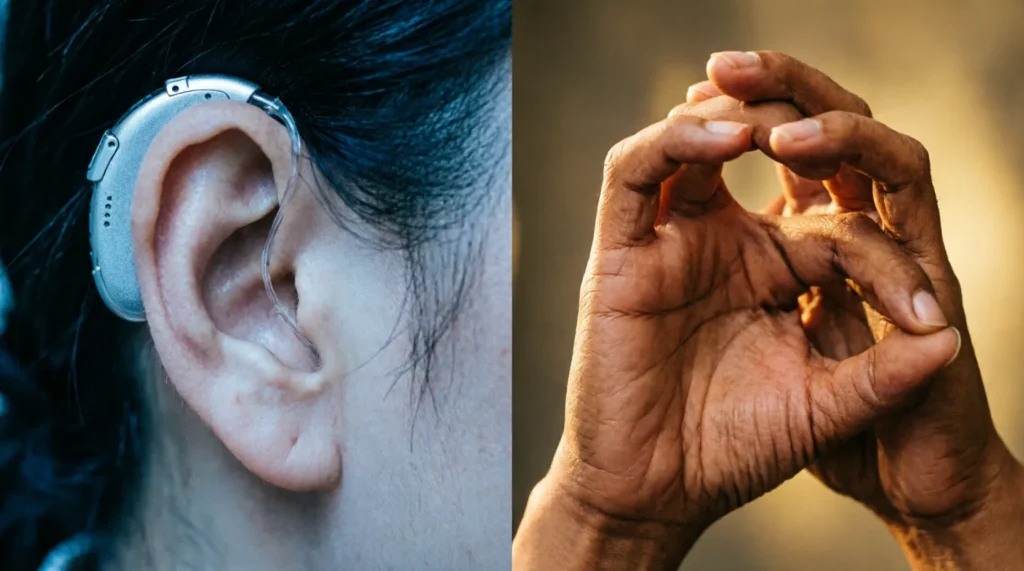
Quick answer: Use lowercase “deaf” when referring to the audiological condition of hearing loss, and uppercase “Deaf” when referring to the cultural identity and community of people who share sign language and Deaf culture. The capital D signals cultural membership, not just a medical diagnosis.
These two spellings trip up writers constantly because they look nearly identical, but they carry fundamentally different meanings. I’ve corrected this distinction in hundreds of manuscripts, from academic papers to nonprofit grant proposals, and it remains one of the most subtle yet significant capitalization rules in English. Getting it wrong doesn’t just break a grammar rule—it can inadvertently offend the very community you’re trying to describe.
| Term | Meaning / When to use | Example sentence |
|---|---|---|
| deaf (lowercase d) | The audiological condition of partial or complete hearing loss; a medical/physical description | “The patient has been deaf since birth due to a genetic condition.” |
| Deaf (uppercase D) | Cultural identity; members of the Deaf community who share sign language, values, and cultural norms | “She’s been active in Deaf advocacy since joining the university’s Deaf student association.” |
When to use deaf
Use lowercase “deaf” when you’re describing the physical condition of hearing loss in a medical, clinical, or general descriptive sense. This is the term you’d use in healthcare settings, insurance documents, or when discussing hearing loss as a disability without reference to cultural identity.
The lowercase form treats deafness as an audiological characteristic, similar to how you’d describe someone as having blue eyes or being left-handed. the lowercase “deaf” refers specifically to “the audiological condition of not hearing” rather than any cultural affiliation.
Here are real-world examples I encounter regularly:
- Medical documentation: “The child was diagnosed as deaf at 18 months during routine hearing screenings.” (I see this exact phrasing in pediatric reports constantly)
- Workplace accommodation requests: “I’m deaf in my left ear and need assistive listening devices for conference calls.” (This appeared in an HR email I edited last month)
- General description: “My grandfather became progressively deaf in his seventies and now uses hearing aids.” (A sentence from a personal essay I proofread)
The key is that you’re describing a physical state, not a cultural identity. Someone can be audiologically deaf without being part of Deaf culture—particularly those who lose hearing later in life, use oral communication methods exclusively, or don’t identify with the Deaf community.
When to use Deaf
Use uppercase “Deaf” when referring to people who identify as members of the Deaf community and participate in Deaf culture. This cultural group shares common experiences, values, traditions, and most importantly, a signed language (such as American Sign Language in the United States).
The capital D is a marker of cultural pride and identity, similar to how we capitalize other cultural and ethnic identities like Hispanic, Indigenous, or Asian. It signals that you’re talking about a sociocultural group, not just a medical condition.
Real examples from my editing work:
- University communications: “The Deaf Studies program hosts monthly film screenings with ASL interpreters.” (From a college brochure I revised)
- Resume/CV language: “Volunteered as a mentor for Deaf youth through the local community center.” (This correction appeared in a graduate school application)
- Social media post: “Proud to be Deaf and raising my children bilingual in ASL and English.” (A LinkedIn post I helped polish)
the distinction between these terms represents more than just orthographic variation—it reflects a fundamental difference in how we conceptualize identity versus condition. The uppercase “Deaf” acknowledges that this is a distinct cultural group with its own language, art, history, and social norms. For more, see Difference.
People who identify as Deaf often view themselves as a linguistic and cultural minority rather than as people with a disability. Many Deaf individuals don’t consider their deafness something to be “fixed” or “cured,” which is why the capitalization matters so much in respectful communication.
How to remember the difference
Here’s the memory trick I teach every intern who joins our editorial team: Capital D = Culture, lowercase d = diagnosis.
Think of it this way: we capitalize proper nouns and the names of specific groups (French, Buddhist, Democrat), and Deaf culture is exactly that—a specific cultural group with its own identity. The lowercase version is just a descriptive adjective, like “tall” or “brunette.”
Another way to remember: if you can replace the word with “hearing-impaired” or “has hearing loss” and the sentence still makes sense, use lowercase “deaf.” If you’re talking about community, identity, or culture—things you can’t replace with a medical term—use uppercase “Deaf.”
I also tell writers to ask themselves: “Am I talking about ears or about people?” Ears get lowercase; people and their cultural identity get uppercase.
Common mistakes and exceptions
The most frequent error I see is using lowercase “deaf” when referring to Deaf culture or the Deaf community, which can come across as dismissive or ignorant of Deaf identity. For instance, writing “the deaf community” instead of “the Deaf community” suggests you view it as a group defined solely by a medical condition rather than a vibrant cultural community.
Another common mistake: assuming everyone with hearing loss identifies as Deaf. Many people who are audiologically deaf don’t participate in Deaf culture and may prefer lowercase “deaf” or other terms like “hard of hearing” or “hearing-impaired.” Always respect individual preferences when known.
US vs. UK considerations: The deaf/Deaf distinction is primarily used in English-speaking countries with established Deaf communities, particularly the United States, Canada, the United Kingdom, and Australia. However, the convention is most strongly observed in American English. Some style guides in other countries may not emphasize this distinction as rigorously. For more, see Between.
Edge cases to watch for:
- Late-deafened adults: Someone who loses hearing after acquiring spoken language typically doesn’t identify as Deaf (uppercase) unless they actively join the Deaf community.
- Hard of hearing: This is a separate term for people with mild to moderate hearing loss who may or may not identify with Deaf culture.
- deafblind: When referring to people with both hearing and vision loss, the compound is typically lowercase unless specifically referring to DeafBlind culture (which has its own distinct identity and uses uppercase).
Style guide variations: The Associated Press (AP) Stylebook now accepts both “deaf” and “Deaf” depending on context, while the Modern Language Association (MLA) and many academic style guides strongly endorse the distinction. When in doubt, follow the preference of the community you’re writing about.
I once edited a nonprofit’s annual report where they consistently used lowercase “deaf” throughout, even when discussing their Deaf leadership council and Deaf cultural programs. We did a global find-and-replace, but it took three hours because the distinction appeared in 47 different places. Don’t be that writer—get it right the first time.
Frequently Asked Questions
Can someone be deaf but not Deaf? Yes, absolutely. Many people have significant hearing loss (deaf, lowercase) but don’t identify with or participate in Deaf culture (Deaf, uppercase). This includes people who lose hearing later in life, those who use only spoken language, or individuals who simply don’t connect with the Deaf community.
Is it offensive to use lowercase “deaf” when talking about Deaf people? It can be, particularly if you’re specifically discussing cultural aspects, community events, or identity. Using lowercase when uppercase is appropriate suggests you view Deaf people through a purely medical lens, which many in the Deaf community find reductive and disrespectful.
What if I don’t know which term someone prefers? When writing about a specific individual, use the term they use for themselves. In general writing about the community, uppercase “Deaf” is the respectful default when discussing cultural identity, while lowercase “deaf” works for medical or audiological contexts. When in doubt, you can also use “deaf or hard of hearing” as an inclusive phrase.
Do all style guides require this distinction? No, but most modern academic, journalistic, and professional style guides now recognize and often require the deaf/Deaf distinction. The AP Stylebook, MLA, APA, and many university style guides all acknowledge this convention. Always check your specific publication’s style guide, but when none exists, following the deaf/Deaf distinction shows cultural competence.

Daniel Perez is a seasoned editor and author with over 10 years of experience in content creation and word analysis. He graduated with a Bachelor’s degree in English Literature from Stanford University, where he discovered his passion for words and their interrelationships. His initial curiosity about wordplay and puns led him to explore deeper linguistic structures, eventually focusing on English word comparisons. Daniel is known for his analytical skills in distinguishing subtle differences between closely related words and expressions. At CompareMyWords, Daniel writes content that caters to both professional linguists and casual language enthusiasts, offering insight into grammatical intricacies, homonyms, and the impact of technology on modern language usage. He is particularly passionate about making linguistic knowledge accessible and engaging to a broad audience.