

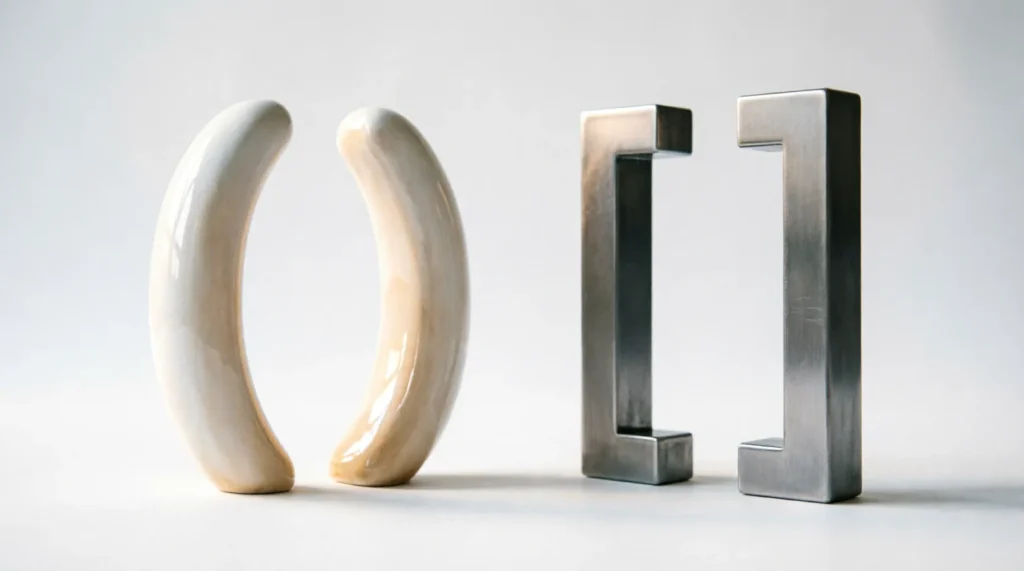
Quick answer: Parentheses ( ) enclose supplementary, non-essential information within a sentence, while square brackets [ ] indicate editorial insertions, clarifications, or modifications inside quoted material. If you can remove the content without breaking the sentence’s grammar, use parentheses; if you are altering or explaining a direct quote, use brackets.
Writers frequently confuse these two punctuation marks because they look similar and both set text apart from the surrounding sentence. However, they serve fundamentally different grammatical and rhetorical functions, and using the wrong one signals carelessness to editors, hiring managers, and academic reviewers. Mastering the difference between parentheses and brackets is not just about following rules; it is about preserving the integrity of your sources and the clarity of your own voice.
| Term | Meaning / When to use | Example sentence |
|---|---|---|
| Parentheses ( ) | Enclose non-essential asides, acronyms, translations, or supplementary details that do not alter the core meaning of the sentence. | The conference keynote (scheduled for 9:00 a.m.) was delayed by technical difficulties. |
| Square Brackets [ ] | Indicate editor-added clarifications, corrections, or omissions within a direct quotation to maintain grammatical flow or provide context. | The witness stated, “She [the defendant] arrived at the scene shortly after midnight.” |
When to Use Parentheses
Parentheses act as a whisper in the middle of a conversation. They allow you to include information that is relevant but not syntactically necessary. According to Parentheses, this mark typically encloses material that could be removed without affecting the grammatical structure or primary meaning of the sentence. In my years of copy editing, I have found that parentheses work best when the enclosed text serves as an aside, a definition, or a brief digression that enriches understanding without demanding the reader’s full attention.
Use parentheses in the following situations:
- Introducing acronyms or abbreviations: Spell out the full term first, then place the abbreviation in parentheses. Example: The National Aeronautics and Space Administration (NASA) announced new funding for lunar research.
- Providing translations or definitions: Offer immediate clarification for foreign terms or jargon. Example: The menu featured coq au vin (chicken braised with wine and mushrooms).
- Adding non-essential commentary or asides: Include personal remarks, humorous observations, or background details that interrupt the main clause gently. Example: My brother (who has never cooked a meal in his life) volunteered to prepare Thanksgiving dinner.
- Citing sources in-text: Follow APA, MLA, or Chicago style conventions for author-date or numerical citations. Example: Recent studies confirm this trend (Smith, 2024).
- Enclosing numbers or letters in lists: Distinguish items within a running list. Example: Please bring (a) identification, (b) proof of address, and (c) two passport photos.
A critical test for parentheses is the removal test. Read the sentence aloud without the parenthetical content. If the sentence remains grammatically complete and logically coherent, parentheses are appropriate. If removing the content creates a fragment or destroys the intended meaning, the information belongs in the main clause, set off by commas or em dashes instead.
I recently edited a cover letter where the applicant wrote, “My experience in project management (which includes leading cross-functional teams of up to 15 people) aligns with your requirements.” The parenthetical was too substantial and disrupted the sentence’s momentum. We revised it to: “My experience in project management, including leading cross-functional teams of up to 15 people, aligns with your requirements.” The commas integrated the detail smoothly, whereas parentheses had made it feel like an afterthought.
When to Use Square Brackets
Square brackets are the editor’s tool, not the writer’s default. They signal intervention. While parentheses suggest the original author included the aside, brackets announce that someone else—usually you, the current writer—has modified the quoted material. This distinction is paramount in academic writing, journalism, legal documentation, and any context where fidelity to source material matters.
Use square brackets in the following situations:
- Clarifying pronouns or ambiguous references in quotes: Replace or supplement vague language so readers understand who or what is being discussed. Example: Original: “He said it was unacceptable.” Edited: “[The CEO] said it was unacceptable.”
- Adjusting verb tense or capitalization for grammatical fit: Modify a quote to match your sentence structure without misrepresenting the source. Example: Original: “running late.” Edited: She admitted she was “[running] late due to traffic.”
- Indicating errors in original sources: Preserve mistakes faithfully while signaling awareness. Example: The letter stated, “Their [sic] decision is final.”
- Translating foreign phrases within quotations: Provide English equivalents directly inside the quoted passage. Example: He whispered, “Je t’aime [I love you],” before departing.
- Nesting punctuation when parentheses already appear: Avoid double parentheses by using brackets for the inner layer. Example: (See Chapter 4 [pages 112–130] for detailed methodology.)
Brackets carry ethical weight. Misusing them can distort meaning or imply endorsement of altered content. I once reviewed a graduate thesis where the student bracketed words into a historical figure’s quote to make it support a modern argument the figure never expressed. The advisor flagged it immediately as scholarly misconduct. Brackets must clarify, not manipulate.
In professional emails, brackets also serve practical purposes. When forwarding a message chain and adding your own note mid-quote, brackets prevent confusion between original and added text. For instance: “Per your request, ‘the budget allocation [adjusted for Q3 inflation] will be finalized Friday.’” This transparency maintains trust in workplace communication.
How to Remember the Difference
The most reliable mnemonic I teach clients is functional, not visual: Parentheses = Personal; Brackets = Borrowed.
If the inserted words are yours and optional, reach for parentheses. If the inserted words modify someone else’s quoted statement, reach for brackets. This rule holds across nearly all standard usage scenarios and eliminates guesswork.
Another helpful trick involves imagining the shape of the marks themselves. Parentheses curve inward, hugging the content like a gentle embrace—suggesting intimacy, informality, and authorial ownership. Brackets stand rigid and angular, resembling architectural scaffolding—suggesting external support, structural intervention, and editorial distance. When you visualize the punctuation this way, the choice becomes intuitive rather than mechanical.
For quick reference during drafting, keep this decision flowchart in mind:
- Is the content inside a direct quotation? → Yes → Use brackets.
- Is the content your own aside, definition, or acronym? → Yes → Use parentheses.
- Are you correcting or clarifying a source’s wording? → Yes → Use brackets.
- Can you delete the content without harming the sentence? → Yes → Use parentheses.
This mental checklist takes seconds and prevents the vast majority of errors I encounter in manuscripts.
Common Mistakes and Exceptions
Even experienced writers stumble over edge cases. Below are the most frequent pitfalls and how to avoid them.
Nesting confusion. When a parenthetical statement requires its own internal parenthesis, switch to square brackets for the inner layer. Never use double parentheses: (see Appendix A (table 3)) is incorrect. Write (see Appendix A [table 3]) instead. Some style guides permit nested parentheses in mathematical or scientific contexts, but in prose, brackets prevent visual clutter and ambiguity.
Overuse of parentheses. Parentheses should spice a sentence, not smother it. If you find yourself using three or more pairs in a single paragraph, reconsider. Excessive parentheticals create a choppy, hesitant rhythm that frustrates readers. Move tangential content to footnotes, separate sentences, or subordinate clauses. I often see resumes littered with parenthetical metrics: “Increased sales (by 22%) (over six months) (in the Northeast region).” Consolidate: “Increased Northeast regional sales by 22% over six months.”
Bracket misuse outside quotations. Outside of direct quotes, brackets rarely belong in standard prose. Using them for general asides (I went to the store [the one on Main Street]) is nonstandard and distracting. Reserve brackets strictly for editorial interventions within quoted material or specialized technical notation.
US vs. UK terminology. In American English, “brackets” refers specifically to square brackets [ ], while “parentheses” means round marks ( ). In British English, “brackets” often denotes round marks, and square brackets are called “square brackets” explicitly. When writing for international audiences or consulting UK-published style guides, verify terminology to avoid miscommunication. The functional distinction remains identical regardless of regional naming conventions.
Punctuation placement. Periods and commas go outside closing parentheses unless the parenthetical is a complete standalone sentence. Compare: We arrived early (the venue opened at noon). versus We arrived early. (The venue opened at noon.) With brackets, punctuation follows the same logic relative to the enclosing sentence, not the bracketed insertion.
According to Difference, precise distinctions between similar concepts prevent ambiguity in communication—a principle that applies directly to punctuation choices. Treating parentheses and brackets as interchangeable erodes the very precision language exists to provide.
Frequently Asked Questions
Can I use parentheses and brackets together in the same sentence? Yes, but only when each serves its distinct function. Parentheses may enclose your own aside while brackets clarify a nested quotation within that aside: (As noted earlier, “the results [of the 2023 trial] were inconclusive.”) Never use them interchangeably or stack them redundantly.
Do brackets change the meaning of a quote? They should not. Brackets clarify grammar, supply missing context, or flag errors—they never alter substantive claims. If bracketed words shift the original intent, paraphrase instead of quoting. Ethical citation demands fidelity over convenience.
Is it ever acceptable to use brackets for non-quoted asides in informal writing? In texting or casual social media, some users adopt brackets stylistically for emphasis or tone. However, in any formal, academic, or professional context, this violates standard conventions and appears unpolished. Stick to parentheses for personal asides regardless of register.
How do I handle punctuation when a parenthetical ends a sentence? Place the period after the closing parenthesis if the parenthetical is part of the sentence: She accepted the offer (despite reservations). If the parenthetical is a complete sentence standing alone, place the period inside: She accepted the offer. (Her reservations proved justified later.)

Daniel Perez is a seasoned editor and author with over 10 years of experience in content creation and word analysis. He graduated with a Bachelor’s degree in English Literature from Stanford University, where he discovered his passion for words and their interrelationships. His initial curiosity about wordplay and puns led him to explore deeper linguistic structures, eventually focusing on English word comparisons. Daniel is known for his analytical skills in distinguishing subtle differences between closely related words and expressions. At CompareMyWords, Daniel writes content that caters to both professional linguists and casual language enthusiasts, offering insight into grammatical intricacies, homonyms, and the impact of technology on modern language usage. He is particularly passionate about making linguistic knowledge accessible and engaging to a broad audience.