

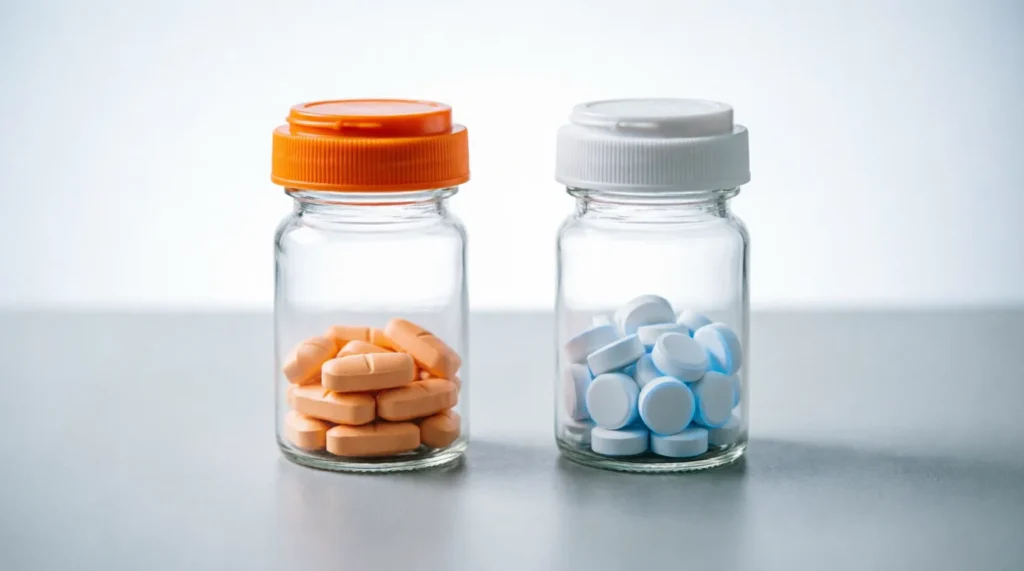
Quick answer: The difference between Percocet and Vicodin is the active opioid ingredient; Percocet contains oxycodone while Vicodin contains hydrocodone, though both are combined with acetaminophen for pain relief.
Patients and caregivers frequently confuse these two brand-name medications because they serve nearly identical clinical purposes and share a similar formulation structure. Both are Schedule II controlled substances prescribed for moderate to severe pain, yet the distinction in their primary active ingredients dictates differences in potency, side effect profiles, and prescribing patterns that matter significantly for patient safety and effective pain management.
| Term | Meaning / When to use | Example sentence |
|---|---|---|
| Percocet | Brand name for a combination of oxycodone and acetaminophen; typically reserved for more severe acute pain due to higher opioid potency. | “The surgeon prescribed Percocet for the first three days following the total knee replacement.” |
| Vicodin | Brand name for a combination of hydrocodone and acetaminophen; often used for moderate pain or as a step-down option from stronger opioids. | “After the dental extraction, the dentist recommended Vicodin every six hours as needed for discomfort.” |
When to use Percocet
Percocet is indicated when pain severity requires the higher receptor affinity and potency of oxycodone. According to Percocet, this medication combines oxycodone hydrochloride with acetaminophen, leveraging the synergistic effect where the non-opioid component enhances analgesia while allowing for a potentially lower opioid dose than might otherwise be necessary. Clinicians select this formulation when hydrocodone-based alternatives have proven insufficient or when the anticipated pain intensity warrants starting at a higher tier of opioid therapy.
- A post-operative orthopedic patient reporting 8/10 pain despite maximum-dose NSAIDs would appropriately receive Percocet rather than a weaker alternative.
- An emergency department physician treating a rib fracture with respiratory compromise may choose Percocet to achieve rapid, reliable analgesia that facilitates deeper breathing.
- A cancer patient experiencing breakthrough pain on a baseline long-acting opioid regimen might use immediate-release Percocet as a rescue medication.
The decision to prescribe Percocet also accounts for individual patient metabolism and prior opioid exposure. Patients who have developed tolerance to hydrocodone through chronic use may find Percocet provides superior relief due to oxycodone’s distinct pharmacokinetic profile. However, this increased potency demands stricter monitoring for respiratory depression, sedation, and misuse potential, making it unsuitable for mild pain or opioid-naïve patients without significant justification.
When to use Vicodin
Vicodin serves as an appropriate choice for moderate pain where oxycodone’s higher potency is unnecessary or poses undue risk. While the original brand-name Vicodin has been discontinued in many markets, generic hydrocodone/acetaminophen combinations remain widely prescribed under the same therapeutic principles. This formulation occupies a middle ground in the opioid analgesic ladder, providing meaningful relief for conditions like dental procedures, minor fractures, or post-surgical recovery where pain is expected to be self-limiting and responsive to less potent agents.
- A patient recovering from wisdom tooth removal typically achieves adequate pain control with Vicodin, avoiding unnecessary exposure to stronger opioids.
- An elderly patient with osteoarthritis flare-ups may benefit from Vicodin’s milder profile, reducing fall risk associated with excessive sedation.
- A clinician stepping down a patient from intravenous hydromorphone after abdominal surgery might transition to oral Vicodin as part of a multimodal pain plan.
Hydrocodone’s slightly lower abuse liability compared to oxycodone—though still substantial—makes Vicodin a pragmatic choice in patients with concerning but not disqualifying substance use histories. The acetaminophen component remains constant across both formulations, meaning liver toxicity risks are identical and strictly dose-dependent regardless of which opioid is selected. Prescribers must calculate total daily acetaminophen intake from all sources, as exceeding 4,000 mg (or lower thresholds in hepatic impairment) risks fulminant liver failure irrespective of whether the opioid partner is hydrocodone or oxycodone.
How to remember the difference
As a copy editor who has reviewed countless medical manuscripts and patient education materials, I see this confusion constantly in discharge instructions and pharmacy labels. The most reliable mnemonic I teach healthcare writers and patients alike focuses on the second letter of each drug’s generic name: Oxycodone pairs with Percocet, while Hydrocodone pairs with Vicodin. Notice that “Percocet” contains an “e” like “oxycodone,” and “Vicodin” contains an “i” like “hydrocodine” (a common misspelling that actually reinforces the link). This orthographic hook works better than semantic associations because brand names are arbitrary; spelling is fixed.
Another editor-level insight involves recognizing that pharmaceutical naming follows no intuitive logic, so relying on sound-alike tricks backfires. Instead, anchor your memory to the prescription label itself: the generic name always appears beneath the brand name in smaller type. If you’re verifying a medication for yourself or a loved one, read that line first before focusing on the branded header. In my years correcting medication errors in patient handouts, I’ve found that training readers to prioritize generic nomenclature eliminates nearly all brand-name confusion, since generics describe chemical reality while brands reflect marketing decisions made decades ago.
For writers producing content about these medications, adopt a style guide rule: always pair the brand name with its generic equivalent on first reference (“Percocet (oxycodone/acetaminophen)”) and use only the generic thereafter. This practice prevents reader confusion, satisfies regulatory clarity standards, and mirrors how clinicians actually communicate in medical records. I once edited a hospital’s post-surgical pamphlet that used “Percocet” and “Vicodin” interchangeably across paragraphs without ever naming the active ingredients; the resulting patient complaints about receiving “the wrong pill” traced directly to that editorial omission. Precision isn’t pedantry here—it’s patient safety.
Common mistakes and exceptions
The most pervasive error I encounter is assuming Vicodin is universally “weaker” and therefore “safer.” While oxycodone is indeed more potent milligram-for-milligram, safety depends entirely on dosing, patient factors, and context. A high-dose hydrocodone prescription can cause fatal respiratory depression just as readily as a low-dose oxycodone one, especially in opioid-naïve individuals or those with sleep apnea. Never equate brand hierarchy with risk hierarchy; instead, evaluate each prescription against the patient’s specific physiology and pain trajectory.
Another critical mistake involves overlooking acetaminophen content when comparing formulations. Both drugs contain varying amounts of acetaminophen per tablet (commonly 325 mg, but historically up to 750 mg in older Vicodin formulations), and patients taking multiple products risk unintentional overdose. I recently corrected a wellness blog that advised readers to “take Tylenol with your Percocet if pain persists,” failing to recognize that Percocet already contains acetaminophen—a recommendation that could easily push someone past safe daily limits. Always verify active ingredients before suggesting adjunctive analgesics.
Regional and temporal variations further complicate comparisons. The term “Vicodin” refers specifically to one manufacturer’s historic formulation; today’s generic equivalents may differ in acetaminophen ratio, bioavailability, or inactive ingredients. Similarly, international readers should note that neither brand name is universally recognized outside the United States, and local formularies may substitute entirely different combination products. Understanding the difference between brand-specific references and class-wide properties prevents dangerous overgeneralization, particularly in cross-border healthcare communication or travel medicine contexts.
Finally, never conflate therapeutic equivalence with interchangeability. Even though both drugs treat similar pain states, switching between them requires dose recalculation using established equianalgesic tables—not simple 1:1 substitution. I’ve seen clinic templates erroneously list “Percocet 5/325 = Vicodin 5/325” as interchangeable options, ignoring that 5 mg oxycodone provides roughly 50% more analgesia than 5 mg hydrocodone. Such oversights lead to underdosing or overdosing during transitions of care. Always consult current conversion guidelines and adjust based on individual response rather than assuming numerical parity implies clinical parity.
Frequently Asked Questions
Can I take Percocet and Vicodin together for better pain relief? No, combining these medications duplicates both the opioid and acetaminophen components, dramatically increasing overdose and liver injury risk without proven additive benefit. Pain uncontrolled by one agent requires clinical reassessment and possible rotation or adjuvant therapy, not stacking similar drugs.
Is Percocet more addictive than Vicodin? Oxycodone has demonstrated higher abuse potential in epidemiological studies and is more frequently implicated in diversion cases, but both carry significant addiction risk as Schedule II opioids. Individual susceptibility depends on genetic, psychological, and environmental factors far more than the specific molecule prescribed.
Why did my doctor switch me from Vicodin to Percocet after surgery? Post-surgical pain often escalates beyond hydrocodone’s effective range, prompting escalation to oxycodone for adequate analgesia during peak inflammation. This transition reflects pain severity management, not judgment about prior treatment adequacy, and should reverse as healing progresses.
Do Percocet and Vicodin show up differently on drug tests? Standard opiate screens detect metabolites specific to each parent compound, so laboratories can distinguish oxycodone from hydrocodone exposure. However, initial immunoassays may cross-react, requiring confirmatory testing to identify the exact substance responsible for a positive result.

Daniel Perez is a seasoned editor and author with over 10 years of experience in content creation and word analysis. He graduated with a Bachelor’s degree in English Literature from Stanford University, where he discovered his passion for words and their interrelationships. His initial curiosity about wordplay and puns led him to explore deeper linguistic structures, eventually focusing on English word comparisons. Daniel is known for his analytical skills in distinguishing subtle differences between closely related words and expressions. At CompareMyWords, Daniel writes content that caters to both professional linguists and casual language enthusiasts, offering insight into grammatical intricacies, homonyms, and the impact of technology on modern language usage. He is particularly passionate about making linguistic knowledge accessible and engaging to a broad audience.